Categories
Autobiography Early Years

My Magic Camera

When we are very young we take ourselves for granted. When I first met other children at school I quickly found out that they were nothing like me. Every encounter with another child was disagreeable. I wasn’t shy, but no one wanted to talk about what mattered to me. It was as though they were in another world. The only things I enjoyed at school from the time I was five until eleven, were dancing, singing and chanting times-tables in unison, spelling tests and hearing some wonderful poems and stories read out to us by the teacher. Everything else was tedious and boring. Every day I longed for the time to go home so that I could read and play the games I invented for myself.

If you want to find out what your own and your children’s personal skills are, the games we make up for ourselves will give us the answers. I did not like dolls, nor babies. But I liked to make a doll with a stick, coloured pencils and pieces of material when I was three years old. As I grew older and could write, I also made a toy theatre out of a shoe box. I painted the backcloth and dressed up some tiny dolls for actors. Then I wrote a play.

I did not like ready- made mechanical toys except for spinning-tops and any toy that required my doing something. It became clear to me as I grew older that I was very imaginative and curious about the strange behaviour of people. I am an observer. Every day I see something worth watching going on wherever I might be. I shop in Waitrose because it is a pleasant place to shop in. I always stop for a cup of tea so that I can watch people, especially the children, because they do just what they want to do and their parents make sure to keep them safe without crushing their enthusiasm. This is a big improvement on what I experienced as a child.

All my life I have seen things as pictures. I still see myself taking imaginery shots with My Magic Camera. Whenever I notice something colourful and well-designed it goes straight into my memory where it waits to come to the surface when I need it. Once it has risen again I can not only see it but I feel its atmosphere and sometimes I remember short stretches of talk.

Even words are pictures to me. Each one has a shape and I very rarely make a spelling error.

My dreams are very helpful to me both as a writer and an artist. I often wake up in the night with new ideas and pictures after I have been reading something connected with my research. My Magic Camera never lets me down both in daytime and when I am asleep. It took me decades to realise that there are very few people with these skills. They were with me since I was born: gifts from my ancestors.

When I was very small, about three or four, I had a strong feeling that I had come from a place far more beautiful than this planet of ours and I wanted to go back to it. Two of my friends had the same experience and many writers, including William Wordsworth and Emily Bronte.

Categories
Autobiography Early Years

War Breaks Out

When I was nine years old we moved house to the posher end of the town, Dawes Heath Road, near the High Street and the school. Mother had decided we needed more room. Her health was failing and she was tired of struggling up the hill to do the shopping.

Most people in those days did not buy houses but rented them. Father thought buying was “a mug’s game”. He was highly suspicious of anyone who wanted money from him. In a way he was right. Being committed to a family was not what he wanted at all. Had he known what was in store for him I think he would have preferred to be a bachelor. But he was a good man and he did his best if somewhat grudgingly.

This house was much bigger with a long garden. Father spent most of his free time growing vegetables and flowers. We had three bedrooms and a proper indoors bathroom and lavatory. Mother was roused to unpredictable bouts of house-cleaning. She liked polishing the red tiles. She even carried out a spring-cleaning once.

Mother went to church when she felt like it. Although she was a Congregationalist, she often tried out other churches, especially the spiritualist sort. She didn’t go as far as The Peculiar People’s Church. I was fascinated by the name. I sometimes waited to see if anyone went in or out. But I never saw a peculiar person, only the usual sort.

By this time we were aware of what was going on in the outside world. I listened to the radio with Dad and sometimes I read the newspaper. I heard Neville Chamberlain on the radio after his return from visiting Hitler. He spoke of Germany as a far-off country that had nothing to do with us. That is unbelievable today, now that the whole world seems so much smaller because of the great changes in the speed of travelling and communication. When we went to the local cinema there was always a news-reel. I saw one of the rallies in Nuremberg. I can remember the atmosphere of power and drama and the disturbing, hectoring voice of Hitler. He was like all the worst teachers rolled into one. Extraordinary rumours abounded: that Hitler was a madman who gnawed his carpet and ate little children for breakfast, like something out of a fairy-story.

I remember the day war was declared. We heard the news on the radio. That day everyone seemed to be on the streets talking in groups. The sense of impending doom was frightening and exciting. We were all waiting for something to happen. During The First World War civilians had hardly been at risk because the aeroplane was still being invented. But we knew what damage could be wreaked because of the bombing in Spain during The Spanish Civil War.

We had a special interest because my eldest Aunt Margaret had married a Spaniard who was in England at the time. He came from a wealthy family that built ships. They lost all their money and my Uncle Ramon stayed in England and ran a small sweetshop for the rest of his life whilst my aunt was a teacher.

It was hearing my uncle speaking Spanish that fired me with a strong desire to learn the language. I was eleven when I began French but I had to wait until I was sixteen to learn Spanish. I took my degree in Hispanic Studies and spent eight years in Venezuela with my husband who worked for Shell. Both my sons were born there. I became virtually bi-lingual.

Categories
Autobiography Early Years

Paradise

Rayleigh is a town built on two levels. We lived at the bottom. Mother found it hard work to push the chair with Colin in it up the steep hill to the High Street. Half way up there was a space where the old castle had stood. The moat that had encircled it was still there. It was a dark eerie place with trees overhanging the green stagnant water. Mary and I loved going there. The first thing we did was run round and round the perimeter, enjoying the feeling of our legs flying through the air. Inside the mount was a small hill and a bigger one. Our aim was to climb to the top of both. The small one was easy but the big one was steep and slippery in the winter. In summer the ground was full of flowers that attracted a myriad of all kinds of insects and butterflies. Lying flat on our stomachs we could see all kinds of tiny creatures and plants. We gazed down through the trees and saw a group of miniature houses far below us. This was the best part. It seemed that they existed only in our eyes. I felt the same excited feeling later in my life when I used to travel back and forth to Scotland. I often caught a glimpse of a bridge leading to a small village. One day I drove there to explore it. I wished I had not done so. The magic faded and it looked like any other seaside town.

I soon learned to write which enabled me to put my stories into words. When we had gone to bed I told endless stories to my sister. She usually fell asleep before I had finished. Although I still did not make friends I discovered that I could round up a small group of boys and girls and organise games for them. Cowboys and Indians was one of my favourites, inspired from my visits to the cinema. I was always the leader of the cowboys and I always won.

We loved Christmas and Guy Fawkes day. These events were eagerly awaited and all the parents did their best to make them fun. In May we enjoyed Empire Day. This was celebrated at school. All the children wore special clothes in red, white and blue. We sang patriotic hymns and songs. Every year there was a carnival in which nearly everyone participated. We had rare days out to the seaside. Everything seemed very peaceful then. Both my parents liked being away from London. My father especially was happier in a country town.

Something wonderful happened to me when I was seven years old. My mother’s sister and her husband invited me to stay with them. I had never seen them before. Most of us rarely saw our relations unless they lived near enough to walk. I couldn’t wait to go. This was the first time I would be away from home. When I think of this now I realise just how independent I must have been. I didn’t miss my family at all, though home looked very welcoming when I returned.

The first adult I ever met, with whom I could have an intelligent conversation was my Uncle Ronald. He was a professional man with a degree in chemistry. My aunt had her first baby who was seven months old. They lived in a much bigger house than ours and my uncle had a car, unusual in those days, so he came over and fetched me to stay with them for two weeks.

Both of them had plenty of time for me. I was the centre of attention and I loved it. He took me out in the car to search for wild birds and flowers. One day he spotted a bright purple flower; stopped the car to walk back and picked it. He hadn’t seen one before. When we got home we looked it up in a book. It turned out to be a variety of wild orchid. He was just as thrilled and excited as I was. That was a new experience for me. I could ask all the questions I wanted and if he didn’t know the answer we would look it up together.

My aunt played the piano. I was bowled-over by this music: the first time I heard any. We could not afford to buy a piano until I was fourteen. In three years I got to grade six. Father told me I was working too hard. “Give it a rest. Moderation in all things!” he said when I played well past bedtime. “If Beethoven had believed that he would never have composed so much beautiful music” I replied. “And a jolly good thing too” he said. “I don’t know what you see in that heavy stuff.” He liked what he called “a good tune”. Once music became more complex he was out of his depth.

Categories
Autobiography Early Years

The Wonders of the Countryside

Wonders of the Countryside by Catherine PainOur time in London was coming to an end. My brother was still sickly and Mother was told that unless we went to live in the country he would not survive. Mother consulted Father and he agreed we should move. She went house-hunting and found an almost new bungalow to let in the country town of Rayleigh, only a few miles from Southend-on-Sea. It was close to the railway station so Father could travel up each day to The City. We were to move at the end of the summer term in 1936. I was the only one at school: Mary was four and Colin was three.

I was very happy at the prospect of leaving the hated London school and moving to the country. I have always liked change. Unlike most people, I believed that new meant better. This proved to be true. Moving to the country was as exciting as I thought it would be.

Mary and I both remember the day we moved from London. It was warm and sunny. The sunbeams shone through the uncurtained windows and flooded the bare floorboards with a shimmering light. It was strange to see the familiar furniture stacked up in piles. Our bedroom looked like an empty box. I was afraid our toys might get lost. I searched anxiously for a small blue doll’s comb. I never found it.

The van came to take our furniture away and we set off for the station. Mother’s deep wicker basket bearing our picnic, went with us.

The journey from London to Rayleigh seemed endless although it was only some thirty miles. At last we arrived. We walked the short distance from the station to Llanberis Avenue and found to our delight that the road was new and had not yet been made. Although there was a narrow concrete footpath at one side, the widest part was a stretch of earth and grass. What had been muddy ruts in the winter were now sun-hardened ridges like brown waves in a solid sea.

The van was already outside our new home, having bumped its way over the uneven surface. The bungalow was all ours. No-one else had the right to the key of our front door. We were thrilled by the veranda, a wooden porch that ran the length of the front of the house, The lavatory was outside. There was no bathroom. We would continue to take our weekly wash-downs in front of the fire in the old tin bath we were used to.

There were only four small rooms: two bedrooms, a living-room and a kitchen. The garden seemed long. By far the most exciting thing was the view from our front door. We faced an open field fringed with tall trees. We raced out to explore and for the first time in our lives we came face to face with blackberry bushes, tall grasses that harboured bright little jewels of wild flowers, elderberry trees and wild rose bushes.

Small white, blue and brown butterflies hovered and we could hear a faint chirping noise which we discovered came from grasshoppers. We had only ever seen such things on the back of cigarette cards.

The sense of freedom was overwhelming. We had come into a new kingdom of our own where we could wander at will, without supervision. Fields that had once been cultivated now lay fallow. The ridges made by the plough had hardened into waves and hollows, like the sea. We delighted in leaping across them as fast as we should go. We played at keeping house in the sun-dried ditches.

Mary and I spent all our time during the summer holidays exploring our new world.

Categories
Autobiography Children Early Years Parents

Getting To Know Me

We all need to make some contact with other people in order to develop our potential as unique beings. To take one example, we would never learn to talk in an easy way unless we are not hearing talk going on around us and to us What gets in the way to our understanding of ourselves is the fear of being isolated through the difficulty in making friends. Wherever there is a group of people of which we are one, this group will have its own ideas about how we should lead our lives. Since we are all individuals, we are all different from each other, with different skills and needs. Since from birth we take a long time to grow to maturity, we go through many different stages to help us to use words and communicate in order to build up a number of rules for ourselves which satisfy our individual needs.

The danger is that in this process, we inevitably pick up other people’s habits that do not suit our own requirements. Freud was the first to make it clear that more trouble is caused by this than by anything else. The big question to which each one of us needs to find an answer is “How can I develop my skills to the full in the way that will give me a worthwhile life and at the same time play my part in making a contribution to the society I live in?”

It took me a long time, most of my long life, to work this out for myself. Since my late ‘teens I have read as much as I could in the area of English literature, philosophy and psychology to find answers about how I could improve my conversation skills without realising that that was what I was doing.

I finally solved the problem of my growing search to learn in what ways I am different from everyone else.

What we do naturally we take for granted, therefore we think that it is easy and everyone can do it. This is a big mistake. For example, one of the greatest errors we make in trying to understand other people is to believe that we all like the same things. Although I have tried to explain to many people that we need to respect these differences, they continue to say “Oh well. Everyone knows that”. They only think they do.

It is hard not to treat parental examples as the truth. It is inevitable that we take in all sorts of beliefs from the cultures in which we live. But we do not have to follow them. Our most powerful need is to think for ourselves. To do that, we must have the freedom to be able to learn what we want, not what our parents want for us. A great many of us do not anyway near achieve our potentials. I am one of the lucky ones.

My main advantage was that I was a first child, born nine months after my parent’s marriage. It was nearly three years before my sister was born, so I had their full interest when I needed it when they were not working. They left me to my own devices. Of course as a child I did not understand what the word ‘love’ meant. I was loved and encouraged most of all by their astonishment at how quickly I learned.

They rarely asked me questions or gave me orders. This is very unusual. From an early age I arranged my own life in choosing what I wanted to do from the wealth of material in my unconscious mind.

My father said of me when I was three, “Jean is sensible”. They expected me to get on with my life without help. As a result I had no impulse to have tantrums or to rebel. Many parents think they have to ‘bring children up’ and ‘teach them right from wrong’. What a waste of time! We all have different ideas about that! Children thrive best with a minimum of guidance of the right kind in an environment of loving care. Going to school was therefore a big disappointment.

Categories
Autobiography Early Years

The Shock of my First School

In the autumn of 1934 I went to school. I went into the Infants department of a new, big and ugly state school. It was nothing like my church school. It was quite a shock to sit in an uncomfortable desk in a serried rank occupied by other children. I soon began to dislike them and the teacher who was sour-faced and harsh in manner.

She began by telling us she was going to teach us to read. Straight away I stood up and said “Please miss. I can read already”. She replied “Take the two children next to you to the front of the class and teach them to read.” I did so. At once she told me to sit down. Much later on when I began to understand that all women were not like Mother I realised that her motive was to punish me for my presumption. I was bewildered. It was my first experience of the teacher saying something she didn’t mean.

Many more followed. One afternoon we returned after lunch and on each desk there was an earring of two black cherries. We were told to draw the cherries and eat them afterwards. I did exactly what she said. I was the first to finish, since I was used to drawing with my mother at home. I promptly ate my cherries. I was supposed to ask the teacher first. Why?

This was my first indoctrination into the rule that we must not do anything until teacher told us. I wasn’t used to other children. They seemed very different from me. They were! Their mothers seemed to be very like my teacher. As a result, the children were full of such comments, learned from their parents, especially their mothers, such as “You’ve done that wrong” or “You are not supposed to do that.” or “ I don’t like your dress,” or hair or anything else they could criticise. I soon learned not to try to talk with any of them. I felt very alone, but I was used to my own company so it didn’t affect me too much.

The only thing I wanted to do there was to join the dancing group. I liked their green tunics trimmed in white and even more the black velvet capes they wore over them. Mother bought the uniform for me and I was allowed to join. I enjoyed the classes very much. We were to give a short show at Christmas time for the parents. We were divided into two groups of three: a driver and two horses. One was the driver with a whip in her hand and two kneeling down in front of her.

To my horror I was chosen to be a horse. I flatly refused. Didn’t they know that I was a natural driver? I dug my heels in and got my own way. I have an old sepia photo of my group. I am brandishing my tinsel whip. My fur-trimmed cap is sliding forward over my face. I can see the triumph in my five-year-old face.

Decades later, reading George Bernard Shaw’s essays, I was pleased to know that I was not alone in my dislike of schools. He believed many of them were not for children but to keep children out of the way of their parents. The writer Charles Dickens, was of the same opinion in his book “Nicholas Nickleby”. When I read the work of Alice Miller, the Swiss psycho-analyst, who coined the phrase “poisonous pedagogy”, I was even more pleased.

Obedience, seen  as a virtue, is what all tyrants want. Hitler is a perfect example. We all have to find our own way in life or we stultify and the essence of our individual nature, dies.

Categories
Autobiography Early Years

Husband and Father

Husband and Father drawing by Catherine PainDespite the discords in my parents’ marriage they both benefited in their own way from each other. Mother was one of those women who love her children most when they are babies. My sister was born when I was nearly three and my brother when I was four. Mother had what she wanted in a home of her own. She didn’t have to worry about getting a job any more. She loved being at home with small children. When we got older and were all at school she missed our company. When I was at grammar school in my early ‘teens Mother would gladly write a note to say I was ill and must stay at home. She tempted Mary and me by offering us a visit to the local cinema in the afternoon. She told us not to tell Father. It didn’t work often because I enjoyed most of my lessons and didn’t t want to miss them. I knew that if I could get to university with a scholarship I could escape from my family and lead a very much better life of my own. By that time everything changed. In many ways I was a child no longer. I knew I had a good mind and I wanted to make full use of it. My teenage years were without doubt the unhappiest days of my life. No-one’s fault, we were just the people we were. What kept me going was my love of reading, learning and classical music.

As soon as I could walk properly, Father took me out on buses to see the sights of London. I vividly remember Buckingham Palace, Hampstead Heath, The Monument and the Zoo. Those visits and the plane trees clinched for me forever a love for London. These jaunts went on until I was seven and we moved to the country for the sake of my brother’s health.

Father didn’t talk to me much but I knew he liked my company. I never complained when my little legs got tired. When I am enjoying myself I can put up with tiredness. In my long life I have maintained that attitude, probably because I have had very few friends: my choice. I like doing things by myself. Father never asked me questions. I believe he liked listening to my enthusiastic reactions to all the new things I saw. He had a family to come home to. He was glad to be free of ‘digs’ . Mother was a good cook and he liked being looked after.

He was not demonstrative, as Mother was. I cannot remember him showing me affection. Probably, with his family history he did not know how to do it. He never criticised his wife in front of us children. Mother often complained to us about him, but never when he was present.

He is the one who bought me books. The first one was “Alice in Wonderland”. It quite overwhelmed me. I loved every bit of it. What a marvelous first book to read. It is perfect for a child who is trying to understand the world through Lewis Carroll’s fantasy and humour. Later he read most of Dickens to us. I have always loved this author and understood him from a wider perspective at different stages as I grew older.

He then purchased an encyclopaedia, The Wonderland of Knowledge, twelve books embossed in dark blue. Much later when I ran my own bookshop I saw many sets of this book, most of them had never been opened. He bought them very cheaply from his newspaper. Mary and I gathered far more from them than what we learned at school, especially ancient history and myths and legends. I also learned to knit from it and began a hobby that lasted for several decades.

Civil servants were not supposed to have strong ideas, especially in politics. He was told not to talk about such matters if he wanted to keep his job. He wisely agreed. This was in the ‘thirties when many people were out of work. He retained his left-wing beliefs but only talked about them to me at home when I was in my last class at junior school. Every Sunday dinner-time he and I would have an emotional argument about politics. This was in 1939 when we were on the brink of war.

By that time my relationship with Dad was not happy. The more I learned to think for myself the more I challenged his beliefs. “Don’t contradict me!” he said. “I am your father!”. I told him that didn’t mean he was always right. He would get red in the face with rage, but I wasn’t frightened of him. It was clear to me that he was very prejudiced. I think he knew it too. When he talked about his hard times in the trenches he never told us one single interesting story. He expaciated on how lucky we were to have all the good things he never had. One day I said to him “All the best soldiers died”. He was silent. But what could an adult expect from a ten-year-old child? It is up to parents to make allowances for children. Not the other way round.

Categories
Autobiography Early Years

Money and Marriage

Alas. My poor parents. The more they wanted from marriage the worse it got. Both had unconventional childhoods of very different kinds. My mother was nothing like her siblings. She missed a lot of schooling because of the many illnesses that she suffered. Yet when she was full of energy and cheerfulness, she always got what she wanted. Her mother was exceptionally intelligent. She (her mother) had some family contacts in Argentina and learned Spanish during a period of more than a year. I think I am much more like her than Mother was. When she got to ninety she still remembered much of her Spanish. My grandfather worked for a Scottish newspaper. He went to London to write reports in the House of Commons. He lost his job and his earnings dropped. Thus the family was always hard up. My mother was often sent to recuperate with her mother’s cousins: gentry living in Lincolnshire. Every Friday a group of ladies met in the drawing-room to Make Things for the Poor. They were served afternoon tea with wafer-thin cucumber sandwiches and delicious cakes on silver cake-stands. Mother was taught to behave like a lady if she walked into the village. She was told to tell anyone she met that she lived at the Manor House and must be called “Miss Dorothy”.

Mother’s beliefs and standards were formed by these visits. She often said that she had married beneath her. With hindsight I think it was the other way round. She missed a lot of schooling, especially arithmetic. She often sent me to the shops to buy food when I was seven years old. She always complained that I should have more change even though I always made sure that it was right.

Mother had no idea how to manage money. The only jobs she managed to get before she married were as companions for wealthy ladies who passed on to her their expensive clothes. She had no trouble finding such positions because everybody liked her lively spirit. When she got married her employer gave her a wedding-dress, covered with glittering beads and made in Paris. It was put away into the wardrobe after her marriage. My sister and I used it to dress up in when we were playing.

As I was the first child, Father paid for a private nursing home for the birth. He brought a present for Mother. It was a bottle of Guiness. She indignantly threw it back to him. She expected flowers and chocolates.

Whenever my parents had arguments it was always about money. Father, according to Mother was a “Mean Old Devil”. The term “I’ll swing for you!” often flew from one to the other. I couldn’t see why they would want to swing for each other. This was something I much enjoyed, but it was obviously meant as an insult.

My first experience of Mother’s money problems came to life before I went to school. In the summer she often took us three children to Finsbury Park. Years later I told her how much I enjoyed that time. All my life, whenever I smelt the scent of privet bushes, I was taken back to that summery paradise. “When did you manage to do the housework?” I asked. “Oh I did it in the evening. I had to stay out in the daytime in case those men came to collect money from me.” I don’t know how she got away with it. She made sure that Father would not find out.

Categories
Autobiography Early Years

My Father

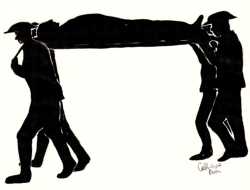
Stretcher Bearers by Catherine PainFather’s birth was shrouded in mystery. His father was drowned at sea before he was born. He was adopted by friends of his father, who promised that if he died before his child was born they would adopt the baby. Until Father was in his ‘teens, he believed he was William Neville. Then he was told he was William Barker. Several questions arise: why did his father think he might be drowned at sea, when that was his job? why was he concerned with the welfare of a child who might or might not be born? Was he or wasn’t he married? He had a legitimate birth certificate which gave his mother’s name as Selina. At that time it was easy enough to discover marriage certificates in London at the end of the 19th Century, but I couldn’t find it.

From the little he told us we gathered that he was not wanted. His adoptive parents already had grown- up daughters. He was given multiple heavy and dirty jobs to do around the house from when he was very young. He was not given love but he was not treated cruelly. When World War 1 broke out Father was the right age to join up and he did so from his own free will. When he went home on leave, his parents would say “Oh it’s you again!” He joined the Army Medical Corps from choice. It was a particularly dangerous job since he spent most of his time working as a stretcher-bearer carrying wounded soldiers off no-man’s-land and helping the doctors. Miraculously he was never wounded.

Father had earned school prizes and developed a love of English Literature, especially Dickens. After the war men like him who were clearly intelligent but had left school at 14, were offered the chance to take a test to become a Civil Servant. Father did so and was very pleased to have a job of some status.

From his personal experiences he had developed a strong sense of social injustice. He was all in favour of education for women. This stood me in good stead in his eyes since he quickly realised that I was exceptionally bright. I didn’t need encouragement or praise, it was enough that Father was dumbfounded by how quickly I learned from a very early age, first at home and in most school subjects.

After the war Father lived in what he called ‘digs’. He lived a bachelor’s life for more than ten years. He had enough money to go to the music halls and to the operas. He developed a strong love of the lighter kind of classical music and the comedy of such stars as Charlie Chaplin. He played the piano when he had the chance, very badly and sang after a fashion all the sentimental songs people loved so much. After all the horrors of the war and poor social conditions it was hardly surprising that many young people longed for a romantic life.

Like many men who fought in the war, Father must have found life very dull once they returned to civilian life. He got tired of living in digs. He wanted to fall in love and have a family. He kept in touch with a few friends from his army days. One of them, Jack, invited him to spend Christmas with his family: mother, father, three sons and four daughters. They created a home-made pantomime. Father loved it. He was the Fairy Queen. For years after he kept in his wardrobe his pink crepe-paper dress and his wand.

He met my mother, who also wanted to settle down, Father was struck by her lively, vivacious and cheerful manner. They soon married and nine months after I was born.

Categories
Autobiography Early Years

My Magic Mother

Unlike some children who only remember sunny weather, I recall the pleasure of dark, stormy times when, bundled up in my pram I was propelled through the streets in my push-chair, snug and warm against the rain and wind to home and the contrast of a glowing fire, protected from danger by a shining brass-railed fire-guard. I would sit transfixed, staring into the caverns of the glowing coals, watching the flickering flames and the ever-changing pictures I saw there. Mother would take down the long-handled toasting-fork which hung on a nail by the fireside. She removed the fire-guard, buttered slices of bread, speared them with the fork and held them dry-side-forward close to the flames until the buttered side had melted.

This concoction she called ‘frizzle-dick”. I don’t know why but they tasted much better than ordinary toast. Probably because Mother had made them. Whatever she offered us to eat always tasted good. We ate what we were given. Money was short and we always enjoyed our meals. When we had finished, Mother took us to bed and told us stories and prayers. Her presence was always magical. We never wanted to let her go. I remember the rough feeling of her work-worn hands (no rubber gloves in those days) as she gently stroked our arms and tucked us into the sheets. Then she went off to prepare Father’s evening meal.

The weather didn’t matter. Mother created her own brand of sunshine. On the rare occasions when she was not at home in my early days at school, the kind Miss West, who lived in the ground-floor flat would let me in, but she was not Mother. The house seemed gloomy and dark without her.

Mother never tried to teach me anything. As soon as I showed interest in something that also interested Mother, she would sit down on the floor next to me and we did things together. I always liked to draw. Mother produced two pieces of brown wrapping-paper and coloured chalks. Every time she drew a church or house in a setting of flowers and trees. Sometimes I copied her and at other times I drew whatever came into my mind.

I loved books and at first enjoyed the pictures. When Mother read the stories to me, I wanted to make sense of the words so that I could read for myself. When I was nearly four I persuaded her to send me to the little church school at the top of our road. I was the first in the class to read and was given a book by Beatrix Potter. From then on I read everything I could lay hands on including street and shop signs. By the time I began school I had read several books.

My church school teacher liked children and always spoke to us in a friendly way. I was shocked when I went to infant school by the sour-faced woman who taught us. It was the first time in my life anyone had spoken to me in such a disagreeable way. From then on I disliked school and the other children.