Categories
Autobiography Early Years

First Impressions

First Impressions by Catherine PainWhat I first remember was being pushed along in a pram gazing up at the greenery of the plane trees that line so many of the London roads. My mother told me later, when I began to learn words, that the only time I cried was when the trees disappeared. Since then, all my life, I have always loved them, big ones and small ones, beautiful in all seasons, even in winter when the lacy patterns of the branches stand out starkly against the pale winter skies. This was the beginning of my interest in all things in nature and my love of walking in peace on my own in all kinds of landscapes.

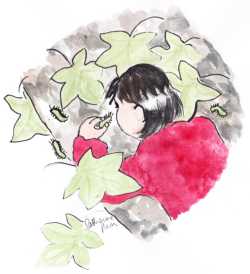
When I was old enough to toddle I walked out of our back door and was astonished to see a tree that lay the length of the garden. I was told that it had been blown down in the night by the wind. I had only seen it upright before, but now I learned how very much bigger they were when seen so close. I clambered into the branches so that I could explore it.

The leaves were a dazzling green. Suddenly I realised that there were many of them moving up and down, whilst the rest of the greenery stayed still. I picked one up. It was warm and furry. I did not know it, but this was was my first sight of a caterpillar. The more I looked the more there were. I still remember how amazed I was that some things I saw were able to move on their own and others could not. I did not know it but I had one of my first lessons from Mother Nature. Things look quite different when they are close and when they are further away.

New knowledge was opening up for me every day. It is some time before newly-borns realise that they are beings in their own right, not part of their mothers. I cannot remember the exact moment when I suddenly felt that I was a separate person with a name of my own and that Mummy and Daddy were also separate people. But in some strange way we belonged to each other and I was aware that they did things for me that I couldn’t do for myself.

Do other babies experience the same thing? I have discovered that most of us remember very little of their early lives. I have come to the conclusion that those of us who do are exceptionally aware not only about what is going on around us but also within ourselves. I believe that those who do are particularly imaginative and sensitive in many different ways. One of the results of these characteristics is that they tend to do things on their own by teaching themselves what they have noticed.

We learn to make the most of ourselves by finding out the kind of people we are. I believe that many of us fail to do the best for ourselves by lacking the confidence to trust our own judgement. I believe my life story, my account of how I reacted to my life’s experience and the benefits I reaped from this, will serve as a good example to young people who have most of their lives before them.

Categories
Autobiography Early Years

The Fear Of Freedom

Goodbye to another Christmas and welcome to another new year. In my eighty second year I have developed from a tiny human being, knowing nothing about this world up to today when I have reached nearly a full lifetime of experiences. It is quite one thing to think about plans for the future when we are young, with what seems to be an endless stretch of time before us, and how we think when at last we realise that we have very little time left.

When we are young we know nothing about the future. We make decisions from the basis of very little knowledge of both the world around us and and even less about what kind of people we are. No-one can know the future but every one of us has individual potentials inherited from our ancesters through the particular genes that we possess. How we use those genes for our own benefit, and for our fellow beings, depends on our making use of our powers to get to know what our real potentials are.

In order to do this we need to learn to observe what is going on around us and inside us. Some kind of guidance is needed but we need to make sure that we are moving in the right direction for ourselves. It is vital that in order to make the best use of our lives we must gradually learn the truth from the false. No-one can teach you this except yourselves. The biggest impediment is the set of beliefs that we pick up from our cultures.

Inevitably we are hampered because of the influence of the society in which we live. Very few people have the courage to work things out for themselves from fear of loneliness. It is easier to fit in with others in order to feel safe. The greatest contributors to universal knowledge work on their own and do not ask for help. Yet they need help but know that the best kind comes from the discoveries of individuals who have lived before us. Not everyone is a genius, but I believe that most of us have the potential to contribute something to the common good. The biggest mistake we make is taking on other people’s ideas without question. Everything should be examined. If they are not, we are liable to turn into bigots who are terrified of changing their minds. For example, when Germany was in dire straits, after World War 1, such a man as Hitler would never have risen to power if enough people recognised what sort of man he was. Erich Fromm was a great writer who recognised in the late thirties the dangers ahead, expressed them very clearly in his book “The Fear of Freedom”. What a wonderful title! It epitomises the fact that to make full use of freedom, we must take full responsbility for ourselves. Any thinking person who has read Hitler’s book “Mein Kampf” would spot the dangers. Had there been more people who did, Hitler would not have been accepted.

My aim for the rest of my life is to tell about my lifelong experiences and the uses I made of them. From my earliest remembered days I have always noticed what was going on around me and tried to make sense of it: especially the way people talk to each other. I have always done what I wanted to do and refused not to go along with any ideas that I thought might be harmful. As I look back on my life I realised that I had achieved everything I wanted to do and it gives me much satisfaction. I took risks that most people would not take and on the whole they were successful. The reason for this is that I always enjoyed what I was doing.

My main aim is to show to young people that they have more power to do what they want than they think. Far too many reach old age and are disappointed about what they have not done. Think for youself, do not accept what you don’t want. Whatever the pressure stick to what you think is right. That is the best and only way to achieve self-confidence.

Categories
Autobiography Behaviour

Edward Heath – ‘I was robbed!’

British Conservative leader Edward Heath at th...
Image via Wikipedia

In all societies it is much easier to copy others than to be yourself. When I was a therapist I found that most of those who came to see me were not happy with their lives yet do not want to pay the price for learning how to make the best of themselves. Two common excuses were they wanted to find a partner “I would be fine if I had someone to come home to” and “just help me to get better by curing my phobias, anorexia, obesity, inability to make friends or whatever”. When I told them I do not do miracles they spent their time with me doing their best to avoid what they needed to understand. It was frustrating work. Some left after a while and a few eventually managed to work things out for themselves with my guidance.

Earlier in my life I ran my second-hand bookshop in the centre of Cambridge and it was amazingly successful. The day I opened there was a queue from the shop to the Round Church. My son and I spent a lot of time travelling looking for books and doing book fairs. We had many customers including some well-known people.

Saturday was the busiest day of the week. One afternoon at about 3 o’clock I looked out of the window and saw Edward Heath [ex British PM – ed], flanked on either side by two stalwart men dressed in black. I assumed they were bodyguards. He was looking straight at my shop window. This is a man I never liked. I hoped he would not come into the shop. But he did. Every inch of the floor space, including the basement, was packed with customers.

I was behind the counter. He came straight up to me with his usual expressionless face. I forced out a smile and said to him “Is there anything I can do for you, Mr. Heath?”

“Yes” he said “Would you tell me how much I should pay for a Speede map of Kent?”

I said “For a first edition?”

“Yes” he said

“It would cost you about £700 pounds.”I replied.

He turned to his two men and said “I think I’ve been robbed!”

I couldn’t believe my ears. I reacted quickly from my high horse. By this time the voices of the customers had subdued somewhat as they noticed what was going on. With a sweet smile I said in a very loud voice “Oh I understand, Mr. Heath. What you want is a free valuation!”

Everyone was silent. Mr.Heath turned a bright puce and strode out of the door followed by his men. An explosion of laughter broke out and the customers clapped energetically. Clearly they disliked this man as much as I did.

Out of this event something very useful happened. One of my regular customers came up to the desk and congratulated me. Then he told me that an old aunt of his had died and would I like to come and have a look at her library. He said that he would usually have asked more than one bookseller for an offer but he was so impressed by the way I managed Mr. Heath that he would accept whatever I suggested. At that time the right kind of old books were getting very hard to find. I paid more money for them than I had ever paid before. It was just what I needed at that time. Here was a man who did not know how important it is to behave well to those who elected him.

Enhanced by Zemanta
Categories
Autobiography

Lucky for Some!

There are two kinds of luck: the kind that hits us out of the blue and the kind that we create for ourselves. The first kind is very rare and we have no control over it. This is the sort that most people believe in. That is why buying lottery tickets is so popular.

When I was very young, every Saturday night at tea-time we all had to keep quiet while my father

listened to the football results to see if he had won a prize. After each check of his completed entry forms he threw down his pencil and recited the same words: “They’ve let me down again!” We all got on with our tea and he got on with his disappointment. I was only five or six at that time but I formed a lifelong promise to myself that somehow or other I would learn how to make my own luck. Talk about role-models! Mine were not of the usual variety, I didn’t copy from my elders, I learned from their mistakes.

After my husband died a few years ago, I moved to a rented house close to my daughter. I looked for a new hairdresser. We chatted together and she asked if I had retired. “Certainly not!” I said “I shall retire the day I die!” I told her I was a writer. “We have a writer in our village. She, too, is an older lady. She is German and has written the story of her life during World War 2.”

“How surprising!” I said. “I have also written a book about my experience during the war.” My first thoughts were “I must meet this lady”. I met Heide Elfenbein and her husband Josef, a professor emeritus and soon made friends for life. I don’t make friends easily. We had so much in common that it was uncanny.

Our discovery of each other could hardly have been a coincidence. It is an excellent example of synchronicity , a discovery of C.G. Jung. We not only have an awareness of our own inner being but there is also such a thing as a connected, or universal unconscious. The more we keep our eyes and ears open the more we increase our creativeness and notice opportunities and most important of all, we feel we are in touch with all living people and all our ancestors.

Our stories were about the same length. Our lives had been so different that I thought if we published the two books in one, they would make a powerful contrast with each other. Heide is well-known in Germany and has published many books including poetry. I was not well known in England. Heide wanted her book to be published in English. I suggested that we should translate her story together. I knew a little German, but I am also a linguist and had some experience of translation from Spanish into English. Heide speaks enough English to get along, but not enough to put her book into a literary style.

We worked together very well and liked each other’s stories. In six months we completed her book into English. Heide had published her book in Germany already some few years ago. We set about looking for publishers in England and Germany. This is not a good time for publishing. So far I have been unable to find one, but I keep looking. Heide found a renowned publisher in Germany and our joint book will be published in March, 2011. As she is well-known in her own country, we have both been invited to Germany for the day of publication so that we can talk to people and sign books. I am learning German as fast as I can.

Heide and I are both entrepreneurs. We both write and paint. We have become very good friends and work well together. Moreover, our outlook on life is very similar. Because of the inevitable influence of propaganda in all countries when wars break out, it has often been taken for granted that the entire German population was firmly supportive of Hitler and his party. Not so. We agree that wartime propaganda lingers on and everyone should know about all those brave German people , including some who were members of the Nazi Party, who risked their own lives because they did not agree with all of Hitler’s ideas, especially the Holocaust.