Categories
Autobiography Early Years

Money and Marriage

Alas. My poor parents. The more they wanted from marriage the worse it got. Both had unconventional childhoods of very different kinds. My mother was nothing like her siblings. She missed a lot of schooling because of the many illnesses that she suffered. Yet when she was full of energy and cheerfulness, she always got what she wanted. Her mother was exceptionally intelligent. She (her mother) had some family contacts in Argentina and learned Spanish during a period of more than a year. I think I am much more like her than Mother was. When she got to ninety she still remembered much of her Spanish. My grandfather worked for a Scottish newspaper. He went to London to write reports in the House of Commons. He lost his job and his earnings dropped. Thus the family was always hard up. My mother was often sent to recuperate with her mother’s cousins: gentry living in Lincolnshire. Every Friday a group of ladies met in the drawing-room to Make Things for the Poor. They were served afternoon tea with wafer-thin cucumber sandwiches and delicious cakes on silver cake-stands. Mother was taught to behave like a lady if she walked into the village. She was told to tell anyone she met that she lived at the Manor House and must be called “Miss Dorothy”.

Mother’s beliefs and standards were formed by these visits. She often said that she had married beneath her. With hindsight I think it was the other way round. She missed a lot of schooling, especially arithmetic. She often sent me to the shops to buy food when I was seven years old. She always complained that I should have more change even though I always made sure that it was right.

Mother had no idea how to manage money. The only jobs she managed to get before she married were as companions for wealthy ladies who passed on to her their expensive clothes. She had no trouble finding such positions because everybody liked her lively spirit. When she got married her employer gave her a wedding-dress, covered with glittering beads and made in Paris. It was put away into the wardrobe after her marriage. My sister and I used it to dress up in when we were playing.

As I was the first child, Father paid for a private nursing home for the birth. He brought a present for Mother. It was a bottle of Guiness. She indignantly threw it back to him. She expected flowers and chocolates.

Whenever my parents had arguments it was always about money. Father, according to Mother was a “Mean Old Devil”. The term “I’ll swing for you!” often flew from one to the other. I couldn’t see why they would want to swing for each other. This was something I much enjoyed, but it was obviously meant as an insult.

My first experience of Mother’s money problems came to life before I went to school. In the summer she often took us three children to Finsbury Park. Years later I told her how much I enjoyed that time. All my life, whenever I smelt the scent of privet bushes, I was taken back to that summery paradise. “When did you manage to do the housework?” I asked. “Oh I did it in the evening. I had to stay out in the daytime in case those men came to collect money from me.” I don’t know how she got away with it. She made sure that Father would not find out.
Categories
Autobiography Early Years

My Father

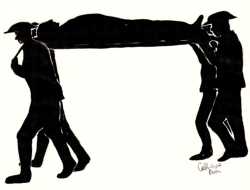
Stretcher Bearers by Catherine PainFather’s birth was shrouded in mystery. His father was drowned at sea before he was born. He was adopted by friends of his father, who promised that if he died before his child was born they would adopt the baby. Until Father was in his ‘teens, he believed he was William Neville. Then he was told he was William Barker. Several questions arise: why did his father think he might be drowned at sea, when that was his job? why was he concerned with the welfare of a child who might or might not be born? Was he or wasn’t he married? He had a legitimate birth certificate which gave his mother’s name as Selina. At that time it was easy enough to discover marriage certificates in London at the end of the 19th Century, but I couldn’t find it.

From the little he told us we gathered that he was not wanted. His adoptive parents already had grown- up daughters. He was given multiple heavy and dirty jobs to do around the house from when he was very young. He was not given love but he was not treated cruelly. When World War 1 broke out Father was the right age to join up and he did so from his own free will. When he went home on leave, his parents would say “Oh it’s you again!” He joined the Army Medical Corps from choice. It was a particularly dangerous job since he spent most of his time working as a stretcher-bearer carrying wounded soldiers off no-man’s-land and helping the doctors. Miraculously he was never wounded.

Father had earned school prizes and developed a love of English Literature, especially Dickens. After the war men like him who were clearly intelligent but had left school at 14, were offered the chance to take a test to become a Civil Servant. Father did so and was very pleased to have a job of some status.

From his personal experiences he had developed a strong sense of social injustice. He was all in favour of education for women. This stood me in good stead in his eyes since he quickly realised that I was exceptionally bright. I didn’t need encouragement or praise, it was enough that Father was dumbfounded by how quickly I learned from a very early age, first at home and in most school subjects.

After the war Father lived in what he called ‘digs’. He lived a bachelor’s life for more than ten years. He had enough money to go to the music halls and to the operas. He developed a strong love of the lighter kind of classical music and the comedy of such stars as Charlie Chaplin. He played the piano when he had the chance, very badly and sang after a fashion all the sentimental songs people loved so much. After all the horrors of the war and poor social conditions it was hardly surprising that many young people longed for a romantic life.

Like many men who fought in the war, Father must have found life very dull once they returned to civilian life. He got tired of living in digs. He wanted to fall in love and have a family. He kept in touch with a few friends from his army days. One of them, Jack, invited him to spend Christmas with his family: mother, father, three sons and four daughters. They created a home-made pantomime. Father loved it. He was the Fairy Queen. For years after he kept in his wardrobe his pink crepe-paper dress and his wand.

He met my mother, who also wanted to settle down, Father was struck by her lively, vivacious and cheerful manner. They soon married and nine months after I was born.

Categories
Autobiography Early Years

My Magic Mother

Unlike some children who only remember sunny weather, I recall the pleasure of dark, stormy times when, bundled up in my pram I was propelled through the streets in my push-chair, snug and warm against the rain and wind to home and the contrast of a glowing fire, protected from danger by a shining brass-railed fire-guard. I would sit transfixed, staring into the caverns of the glowing coals, watching the flickering flames and the ever-changing pictures I saw there. Mother would take down the long-handled toasting-fork which hung on a nail by the fireside. She removed the fire-guard, buttered slices of bread, speared them with the fork and held them dry-side-forward close to the flames until the buttered side had melted.

This concoction she called ‘frizzle-dick”. I don’t know why but they tasted much better than ordinary toast. Probably because Mother had made them. Whatever she offered us to eat always tasted good. We ate what we were given. Money was short and we always enjoyed our meals. When we had finished, Mother took us to bed and told us stories and prayers. Her presence was always magical. We never wanted to let her go. I remember the rough feeling of her work-worn hands (no rubber gloves in those days) as she gently stroked our arms and tucked us into the sheets. Then she went off to prepare Father’s evening meal.

The weather didn’t matter. Mother created her own brand of sunshine. On the rare occasions when she was not at home in my early days at school, the kind Miss West, who lived in the ground-floor flat would let me in, but she was not Mother. The house seemed gloomy and dark without her.

Mother never tried to teach me anything. As soon as I showed interest in something that also interested Mother, she would sit down on the floor next to me and we did things together. I always liked to draw. Mother produced two pieces of brown wrapping-paper and coloured chalks. Every time she drew a church or house in a setting of flowers and trees. Sometimes I copied her and at other times I drew whatever came into my mind.

I loved books and at first enjoyed the pictures. When Mother read the stories to me, I wanted to make sense of the words so that I could read for myself. When I was nearly four I persuaded her to send me to the little church school at the top of our road. I was the first in the class to read and was given a book by Beatrix Potter. From then on I read everything I could lay hands on including street and shop signs. By the time I began school I had read several books.

My church school teacher liked children and always spoke to us in a friendly way. I was shocked when I went to infant school by the sour-faced woman who taught us. It was the first time in my life anyone had spoken to me in such a disagreeable way. From then on I disliked school and the other children.

Categories
Autobiography Early Years

First Impressions

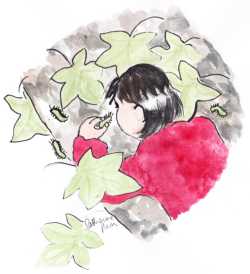
First Impressions by Catherine PainWhat I first remember was being pushed along in a pram gazing up at the greenery of the plane trees that line so many of the London roads. My mother told me later, when I began to learn words, that the only time I cried was when the trees disappeared. Since then, all my life, I have always loved them, big ones and small ones, beautiful in all seasons, even in winter when the lacy patterns of the branches stand out starkly against the pale winter skies. This was the beginning of my interest in all things in nature and my love of walking in peace on my own in all kinds of landscapes.

When I was old enough to toddle I walked out of our back door and was astonished to see a tree that lay the length of the garden. I was told that it had been blown down in the night by the wind. I had only seen it upright before, but now I learned how very much bigger they were when seen so close. I clambered into the branches so that I could explore it.

The leaves were a dazzling green. Suddenly I realised that there were many of them moving up and down, whilst the rest of the greenery stayed still. I picked one up. It was warm and furry. I did not know it, but this was was my first sight of a caterpillar. The more I looked the more there were. I still remember how amazed I was that some things I saw were able to move on their own and others could not. I did not know it but I had one of my first lessons from Mother Nature. Things look quite different when they are close and when they are further away.

New knowledge was opening up for me every day. It is some time before newly-borns realise that they are beings in their own right, not part of their mothers. I cannot remember the exact moment when I suddenly felt that I was a separate person with a name of my own and that Mummy and Daddy were also separate people. But in some strange way we belonged to each other and I was aware that they did things for me that I couldn’t do for myself.

Do other babies experience the same thing? I have discovered that most of us remember very little of their early lives. I have come to the conclusion that those of us who do are exceptionally aware not only about what is going on around us but also within ourselves. I believe that those who do are particularly imaginative and sensitive in many different ways. One of the results of these characteristics is that they tend to do things on their own by teaching themselves what they have noticed.

We learn to make the most of ourselves by finding out the kind of people we are. I believe that many of us fail to do the best for ourselves by lacking the confidence to trust our own judgement. I believe my life story, my account of how I reacted to my life’s experience and the benefits I reaped from this, will serve as a good example to young people who have most of their lives before them.

Categories
Autobiography Early Years

The Fear Of Freedom

Goodbye to another Christmas and welcome to another new year. In my eighty second year I have developed from a tiny human being, knowing nothing about this world up to today when I have reached nearly a full lifetime of experiences. It is quite one thing to think about plans for the future when we are young, with what seems to be an endless stretch of time before us, and how we think when at last we realise that we have very little time left.

When we are young we know nothing about the future. We make decisions from the basis of very little knowledge of both the world around us and and even less about what kind of people we are. No-one can know the future but every one of us has individual potentials inherited from our ancesters through the particular genes that we possess. How we use those genes for our own benefit, and for our fellow beings, depends on our making use of our powers to get to know what our real potentials are.

In order to do this we need to learn to observe what is going on around us and inside us. Some kind of guidance is needed but we need to make sure that we are moving in the right direction for ourselves. It is vital that in order to make the best use of our lives we must gradually learn the truth from the false. No-one can teach you this except yourselves. The biggest impediment is the set of beliefs that we pick up from our cultures.

Inevitably we are hampered because of the influence of the society in which we live. Very few people have the courage to work things out for themselves from fear of loneliness. It is easier to fit in with others in order to feel safe. The greatest contributors to universal knowledge work on their own and do not ask for help. Yet they need help but know that the best kind comes from the discoveries of individuals who have lived before us. Not everyone is a genius, but I believe that most of us have the potential to contribute something to the common good. The biggest mistake we make is taking on other people’s ideas without question. Everything should be examined. If they are not, we are liable to turn into bigots who are terrified of changing their minds. For example, when Germany was in dire straits, after World War 1, such a man as Hitler would never have risen to power if enough people recognised what sort of man he was. Erich Fromm was a great writer who recognised in the late thirties the dangers ahead, expressed them very clearly in his book “The Fear of Freedom”. What a wonderful title! It epitomises the fact that to make full use of freedom, we must take full responsbility for ourselves. Any thinking person who has read Hitler’s book “Mein Kampf” would spot the dangers. Had there been more people who did, Hitler would not have been accepted.

My aim for the rest of my life is to tell about my lifelong experiences and the uses I made of them. From my earliest remembered days I have always noticed what was going on around me and tried to make sense of it: especially the way people talk to each other. I have always done what I wanted to do and refused not to go along with any ideas that I thought might be harmful. As I look back on my life I realised that I had achieved everything I wanted to do and it gives me much satisfaction. I took risks that most people would not take and on the whole they were successful. The reason for this is that I always enjoyed what I was doing.

My main aim is to show to young people that they have more power to do what they want than they think. Far too many reach old age and are disappointed about what they have not done. Think for youself, do not accept what you don’t want. Whatever the pressure stick to what you think is right. That is the best and only way to achieve self-confidence.